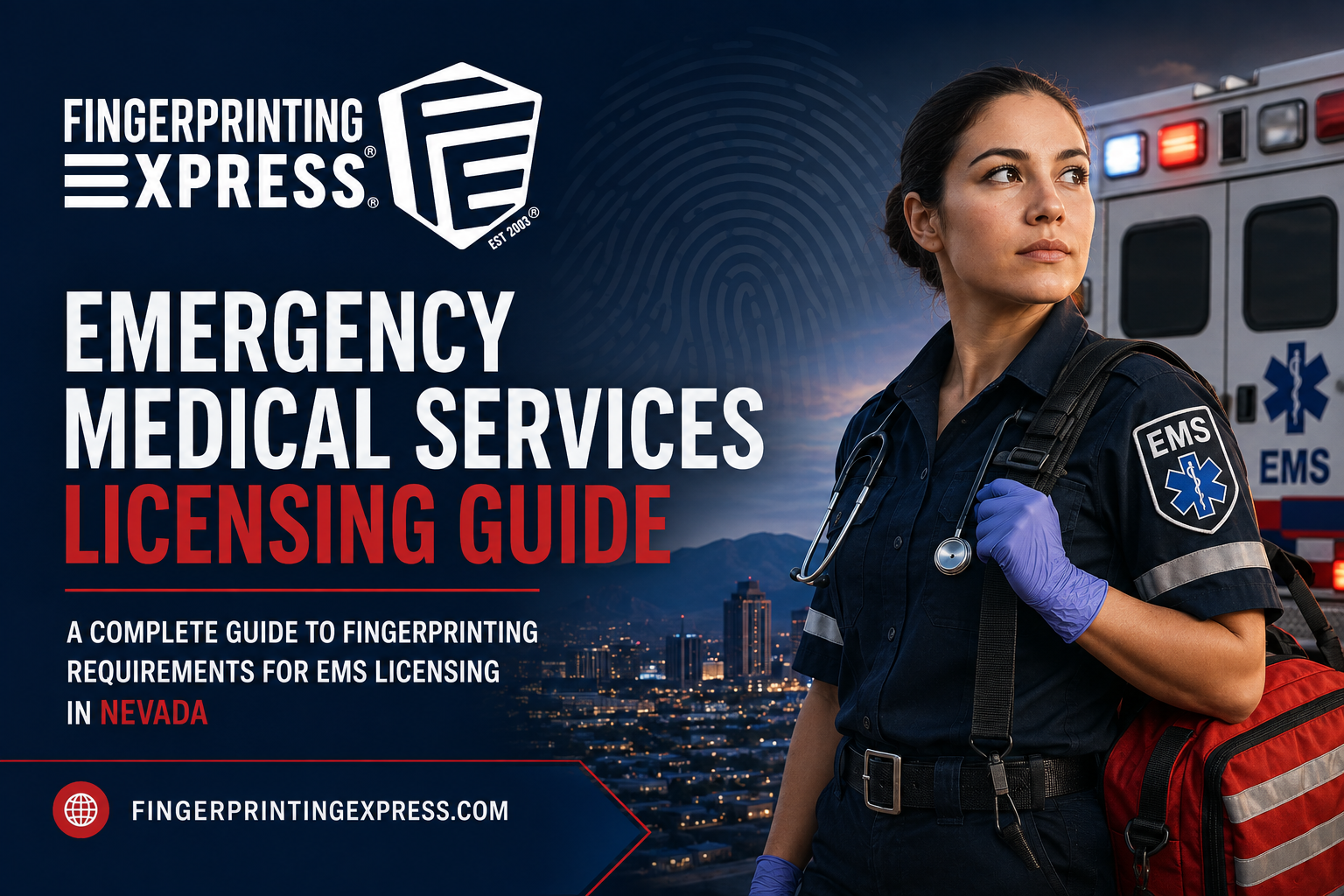
Emergency Medical Services Fingerprinting Requirements in Nevada: The Complete Licensing Guide
Every EMT, AEMT, and paramedic applicant in Nevada must pass a fingerprint-based criminal history check before the state will issue a license or certificate. Fingerprints are submitted electronically through Livescan or, in some cases, on paper FD 258 cards, and are routed to the Nevada Department of Public Safety Records Bureau and the FBI. The check is required under NRS 450B.180 and enforced locally by the Nevada Office of EMS and Trauma System (northern and rural counties) or the Southern Nevada Health District (Clark County). Applicants pay for the fingerprinting service itself, separate from any state licensing fee, and many fire departments direct new hires to an approved civilian Livescan vendor such as Fingerprinting Express to complete this step quickly and correctly the first time.
That is the short version. The rest of this guide walks through the baseline requirements you need before you even apply, exactly how the fingerprinting and licensing process works, what can disqualify an applicant, how city fire department contracts fit in, and why getting the fingerprinting step right the first time matters for anyone entering the EMS field.
Baseline Requirements Before You Apply
Before a Nevada EMS training program or fire department will even consider an application, most require the following baseline qualifications. These are the general benchmarks; individual programs and departments can add requirements on top of this list.
- Minimum age. Generally 18 for EMT, AEMT, and paramedic programs; some Emergency Medical Responder (EMR) courses accept 16 or 17 year olds with restrictions.
- High school diploma or GED.
- Current CPR card. A CPR for Healthcare Providers (BLS) card is required to enter most EMT, AEMT, and paramedic programs and must stay current through certification.
- Valid driver’s license and clean driving record. Ambulance and fire agencies review motor vehicle records, and out-of-state applicants are typically asked to provide their prior state’s driving history.
- Immunizations and a physical exam. Most programs require proof of immunizations, a TB test, and a physical exam before starting clinical rotations or ride alongs.
- Program level admission screening. Some colleges and training centers, particularly for AEMT and paramedic programs that include clinical rotations, run their own criminal background check and drug screen as a condition of admission into the program itself. This is separate from, and happens earlier than, the state licensing fingerprint check described later in this guide.
How to Become an EMT in Nevada, Step by Step
This is the path most people follow before they ever sit for a fingerprinting appointment.
- Meet the baseline requirements above. Age, diploma or GED, and a current CPR card.
- Enroll in a Nevada approved EMT training program. EMT courses generally run around 200 hours and must meet U.S. Department of Transportation and National Highway Traffic Safety Administration education standards. Programs are offered through community colleges, private EMS training centers, and some fire departments.
- Complete required clinical or field time. Most programs include ride alongs or clinical hours in addition to classroom and skills lab instruction.
- Pass the final course exam and receive your certificate of completion. An 80 percent or higher is a typical passing benchmark.
- Pass the NREMT cognitive and psychomotor exams. The National Registry of Emergency Medical Technicians cognitive exam is computer based and available at testing centers; the psychomotor exam tests hands on skills such as patient assessment and trauma management.
- Apply for Nevada EMS certification. This is where fingerprinting enters the picture. Once you have your course completion certificate and NREMT passage in hand, you submit your state application along with fingerprints for a criminal history check, described in detail below.
- Receive your Nevada EMT certification and get hired. Ambulance services, hospitals, and fire departments typically run their own hiring process, including a separate employment background check, on top of your state certification.
How to Become a Firefighter in Nevada, Step by Step
Firefighter hiring runs on a parallel but distinct track. Most Nevada fire departments require EMT certification, and increasingly AEMT or paramedic certification, as a condition of employment, so the EMT path above is usually step one for an aspiring firefighter.
- Meet minimum firefighter hiring qualifications. Typically 18 years or older, high school diploma or GED, valid driver’s license, and no disqualifying criminal history.
- Earn EMT certification (or higher). Nearly every Nevada fire department requires at least a current EMT certification at the time of hire; many now prefer or require AEMT or paramedic level certification.
- Complete Firefighter I and Firefighter II certification. These are separate, standardized certifications (often through a community college fire academy or a department sponsored academy) covering fire behavior, suppression tactics, hazardous materials awareness, and physical performance standards.
- Obtain additional endorsements as required. Many departments also require or prefer a Hazardous Materials Awareness/Operations certification and a current ACLS card for paramedic level hires.
- Apply to an open fire department recruitment. Departments post recruitments periodically rather than hiring on a rolling basis; applications typically include a written exam, a physical ability test (CPAT), and an oral interview panel.
- Complete a background investigation and fingerprint based check. This is the employment level check described in the City Fire Department Contracts section below, separate from your state EMS certification fingerprint check, and is where many departments direct applicants to a designated Livescan vendor such as Fingerprinting Express.
- Complete a fire academy and probationary period. Successful candidates attend the department’s or a regional fire academy, followed by a probationary period on shift.
With the baseline requirements and education path covered, the rest of this guide focuses on the fingerprinting and criminal history side of the process, which applies whether you are pursuing EMT certification on its own or using it as a stepping stone into a firefighter career.
Why EMS Personnel Undergo Fingerprint Based Background Checks
Emergency medical technicians, advanced EMTs, and paramedics are granted access to patients at their most vulnerable moments: in their homes, in the back of an ambulance, unconscious, in pain, or in the middle of a crisis. They also handle controlled substances, patient records, and property inside private residences. Because of that level of trust, Nevada treats EMS licensure the same way it treats nursing, teaching, and other public facing professions that require a fingerprint-based criminal history check rather than a simple name based search.
A fingerprint-based check does two things a name check cannot:
- It confirms the applicant’s true identity against a unique biometric record, closing the door on aliases or stolen identities.
- It searches criminal history at both the state level (through the Nevada Department of Public Safety Records Bureau) and the federal level (through the FBI), surfacing convictions from other states that a Nevada only search would miss.
This is also why Nevada, like most states, requires fingerprint based checks as a condition of licensure under the new EMS Personnel Licensure Interstate Compact framework described in NRS 450B.145, which coordinates reciprocity for EMS licensees who work across state lines while still holding every member state to a common, FBI compliant background check standard.
The Two Agencies Governing Nevada EMS Licensing
Nevada splits EMS licensing oversight geographically, and knowing which agency governs your application matters:
| Region | Governing Agency | Statutory Basis |
| Clark County (Las Vegas, Henderson, North Las Vegas) | Southern Nevada Health District, Office of EMS and Trauma System | NRS 450B, NAC 450B |
| Washoe County, rural counties, and statewide oversight | Nevada Division of Public and Behavioral Health, Office of EMS and Trauma System | NRS 450B, NAC 450B |
Both offices apply the same core statute, NRS 450B.180, which authorizes the health authority to require fingerprints and a criminal history review as part of certifying an EMT, AEMT, or paramedic. Both also accept fingerprints collected by approved third party Livescan vendors, which is where a company like Fingerprinting Express fits into the pipeline for applicants, EMS training programs, and fire departments alike.
From Training Completion to Licensure: The Fingerprinting and Certification Process
Once you have finished your training program and passed your NREMT exams (see the step by step paths above), here is exactly what happens on the fingerprinting and licensing side.
- Submit fingerprints for a criminal history check. This is the step most applicants underestimate. The applicant is fingerprinted, either electronically through Livescan or on a physical FD 258 card, and authorizes the state to forward the prints to the Nevada Department of Public Safety Records Bureau and the FBI for a full background review. Choosing an approved, experienced Livescan provider here avoids the single most common cause of delay: rejected or unreadable prints.
- Complete the licensure application. The applicant submits the state application, proof of course completion, proof of NREMT passage, a current CPR card, and, in many cases, a physical exam and TB test result.
- Wait for the criminal history determination. The health authority reviews the fingerprint-based results against a defined list of disqualifying and reviewable offenses (see below) and either approves, denies, or requests additional documentation.
- Receive certification and register with an EMS or fire agency. Once licensed, the individual can be hired by a fire department, private ambulance service, or hospital-based EMS program, most of which require a fresh fingerprint-based background check as a condition of employment, on top of the state license.
- Recertify on schedule. Nevada EMS certifications renew every two years with continuing education (40 hours for EMT, 50 for AEMT, 60 for paramedic, under NAC 450B.380). The fingerprint-based criminal history check itself is required again every 6 years rather than at every renewal, unless a department requires its own repeat check at hire or after a break in service.
What Can Disqualify an EMS Applicant
Nevada’s review is not automatically disqualifying for every past offense. The Office of EMS and Trauma System applies a graduated review, generally along these lines (always confirm current criteria directly with the licensing health authority, since these standards are periodically updated):
- Minor traffic incidents, minor citations, or juvenile offenses occurring more than a few years before application are generally treated more leniently than recent or repeated offenses.
- Certain categories are treated as serious regardless of how long ago they occurred, including offenses involving abuse, neglect, or exploitation of an older or vulnerable person under NRS 200.5099 or NRS 200.50955; Medicare or Medicaid fraud resulting in program exclusion; fraud, theft, embezzlement, burglary, or robbery within the recent look back period; and felonies involving a firearm or other deadly weapon.
- Applicants who are denied receive written notice and have a limited window, typically 30 days, to request a review from the Health Officer.
Because these categories are specific and the review is fact dependent, applicants with any criminal history on record should talk to the licensing health authority directly rather than assuming an old or minor incident will be an automatic bar.
City Fire Department Contracts and Who Pays for Fingerprinting
Municipal and county fire departments across Nevada bring on new EMTs and paramedics constantly, whether through direct hire, academy classes, or lateral transfers from other jurisdictions. Most departments require applicants to complete their own fingerprint-based background check as part of the hiring process, separate from (and often in addition to) the state licensing fingerprint check.
Fingerprinting Express holds active contracts with a number of city fire departments to serve as their designated fingerprinting provider for new EMS and fire hires. Under this model, the fire department directs applicants to Fingerprinting Express to complete their Livescan or card based fingerprinting, and the organization pays for the fingerprinting service directly at the time of the appointment. This structure keeps the cost off the department’s budget while ensuring every applicant is processed by a vendor that specializes in high volume, compliance sensitive fingerprinting rather than a general purpose print shop.
For a fire department, the value of a dedicated fingerprinting partner comes down to three things:
- A rejected or smudged print set sends an applicant back to square one and can delay a hiring class by weeks. Fingerprinting Express maintains an extremely low fingerprint rejection rate because technicians are trained specifically on capture technique, not just software operation.
- Livescan submissions must route correctly to the appropriate state and federal channels (Nevada Department of Public Safety, FBI, and, where applicable, agencies like the FDLE for candidates with Florida ties). An experienced vendor already has these channels configured correctly.
- Departments running academy classes or seasonal hiring surges need an applicant to be printed and cleared to schedule on short notice, without the applicant needing to travel far or wait days for an appointment.
If your fire department, EMS agency, or training program does not yet have a designated fingerprinting partner, that is a gap worth closing before your next hiring cycle rather than after a delayed start date.
Frequently Asked Questions
Do EMTs and paramedics need to be fingerprinted in Nevada?
Yes. Nevada law (NRS 450B.180) requires a fingerprint-based criminal history check before the state will certify or license an EMT, AEMT, or paramedic.
Who pays for EMS fingerprinting, the applicant or the department?
In most contracted arrangements, the applicant pays for the fingerprinting service directly when their fire department or hiring agency directs them to a designated vendor such as Fingerprinting Express. The fingerprinting fee is separate from the state’s licensing application fee. Some City organizations may cover all of the fees.
Can I use any fingerprinting company for my EMS application?
You need a provider capable of routing prints correctly to the Nevada Department of Public Safety Records Bureau and the FBI, and, if your hiring agency has a designated contracted vendor, you generally need to use that vendor. Ask your training program or fire department which provider they require.
Will a past criminal record automatically disqualify me from EMS licensure in Nevada?
Not automatically. The licensing health authority applies a graduated review based on the nature of the offense and how long ago it occurred, with certain serious offense categories weighted more heavily. Applicants with any record should contact the Office of EMS and Trauma System or Southern Nevada Health District directly before applying.
Do I need to be fingerprinted again if I move from another state or renew my license?
Requirements vary. Many agencies require a new fingerprint based check at hire even for an already licensed EMT, and some require a repeat check at renewal or after a break in service. The new EMS Personnel Licensure Interstate Compact is also expected to standardize FBI compliant fingerprint checks across member states for reciprocity purposes.
What do I need to complete before I get fingerprinted for EMS certification?
You need to finish your Nevada-approved EMT, AEMT, or paramedic training program and pass the NREMT cognitive exam (plus the psychomotor exam for AEMT and paramedic levels) first. Fingerprinting happens when you submit your state certification application, not before you start your training. Some college based AEMT and paramedic programs do run their own separate background check for admission into clinical rotations, which happens earlier and is distinct from the state licensing fingerprint check.
How long does the EMS fingerprint and background check process take?
Turnaround depends on the fingerprint vendor and the state or FBI channel, but using an experienced, low rejection rate provider is the single biggest factor within an applicant’s control for avoiding delays.
Why Fire Departments and Applicants Choose Fingerprinting Express
Fingerprinting Express has operated as a livescan fingerprinting and compliance services company since 2003, with locations across the Las Vegas and Reno areas. FE holds close to a thousand active institutional contracts, including agreements with city fire departments, and maintains one of the lowest fingerprint rejection rates in the industry. That track record matters most in EMS hiring, where a single rejected print set can push back an academy start date or delay a badge for a working paramedic.
FE is also an approved Livescan vendor for out of state channels, including the FDLE in Florida, which matters for EMS professionals with multistate ties or reciprocity needs. Every technician is trained under FE’s Culture To Care standard, built specifically around the reality that many applicants walking through the door are nervous, time pressured, or unfamiliar with the process, exactly the profile of a new EMT starting a career in public safety.
Whether you are a fire department building or refreshing a fingerprinting partnership for your next hiring class, an EMS training program advising students on next steps, or an individual applicant trying to get licensed without delay, Fingerprinting Express is built to be the fast, accurate, compliant first step in the process. Departments can also route new hires to our HireHealth team for the pre-employment physicals, TB testing, and drug testing that typically round out an EMS or fire hiring packet.
Sources and Further Reading
- NRS 450B.180, Certification and authority of emergency medical technicians, advanced emergency medical technicians and paramedics — Nevada Legislature
- NRS 450B.145, EMS Personnel Licensure Interstate Compact — Justia Law
- NAC 450B, Emergency Medical Services regulations — Nevada Legislature
- Nevada DPBH, Office of EMS and Trauma System, EMS FAQs — Nevada Division of Public and Behavioral Health
- Southern Nevada Health District, Fingerprint Based Criminal History Criteria — SNHD Office of EMS and Trauma System
- Fingerprinting Express, Nevada Livescan and FBI Fingerprint Forms FAQ
Last reviewed: August 2026. Regulations referenced below are current as of this writing; always confirm current requirements with the Nevada Division of Public and Behavioral Health, Office of EMS and Trauma System, or your local health district before submitting an application.
This article is intended for general informational purposes and does not constitute legal advice. Nevada EMS licensing statutes and administrative code are subject to change; verify current requirements with the Nevada Division of Public and Behavioral Health, Office of EMS and Trauma System, or the Southern Nevada Health District before relying on any detail above for an active application.